Stop Guessing.
Start Knowing
Identify your real skin type and transform your skin.
Get Your InstantSkin Care Routine
Have you ever noticed that your skin behaves differently depending on the weather? Your face might become unusually oily during summer, feel tight during winter, or develop dry patches when the seasons change.
You may even find that a moisturizer that works perfectly in January feels too heavy in June.
These changes are not unusual. Weather can influence how your skin feels, how much oil appears on its surface, and how effectively it retains moisture.
Temperature, humidity, wind, sunlight, and environmental conditions all play a role. However, oily, dry, and combination skin do not respond to these changes in exactly the same way.
Understanding how different weather conditions affect your skin can help you make sensible adjustments to your skincare routine without constantly switching products.
Why Does Weather Affect Your Skin?
Your skin acts as a protective barrier between your body and the environment. Its outermost layer helps retain water while protecting against irritants and external conditions.
When the weather changes, the environment surrounding your skin changes too.
Hot weather can increase sweating and make oiliness more noticeable. Cold temperatures and dry air may contribute to moisture loss. Wind can make exposed skin feel uncomfortable, while strong sunlight increases exposure to ultraviolet radiation.
Humidity is another important factor.
When the air contains more moisture, water evaporates from the skin differently than it does in a dry environment. However, high humidity does not automatically mean your skin is properly hydrated.
Your natural skin type also influences how these conditions affect you.
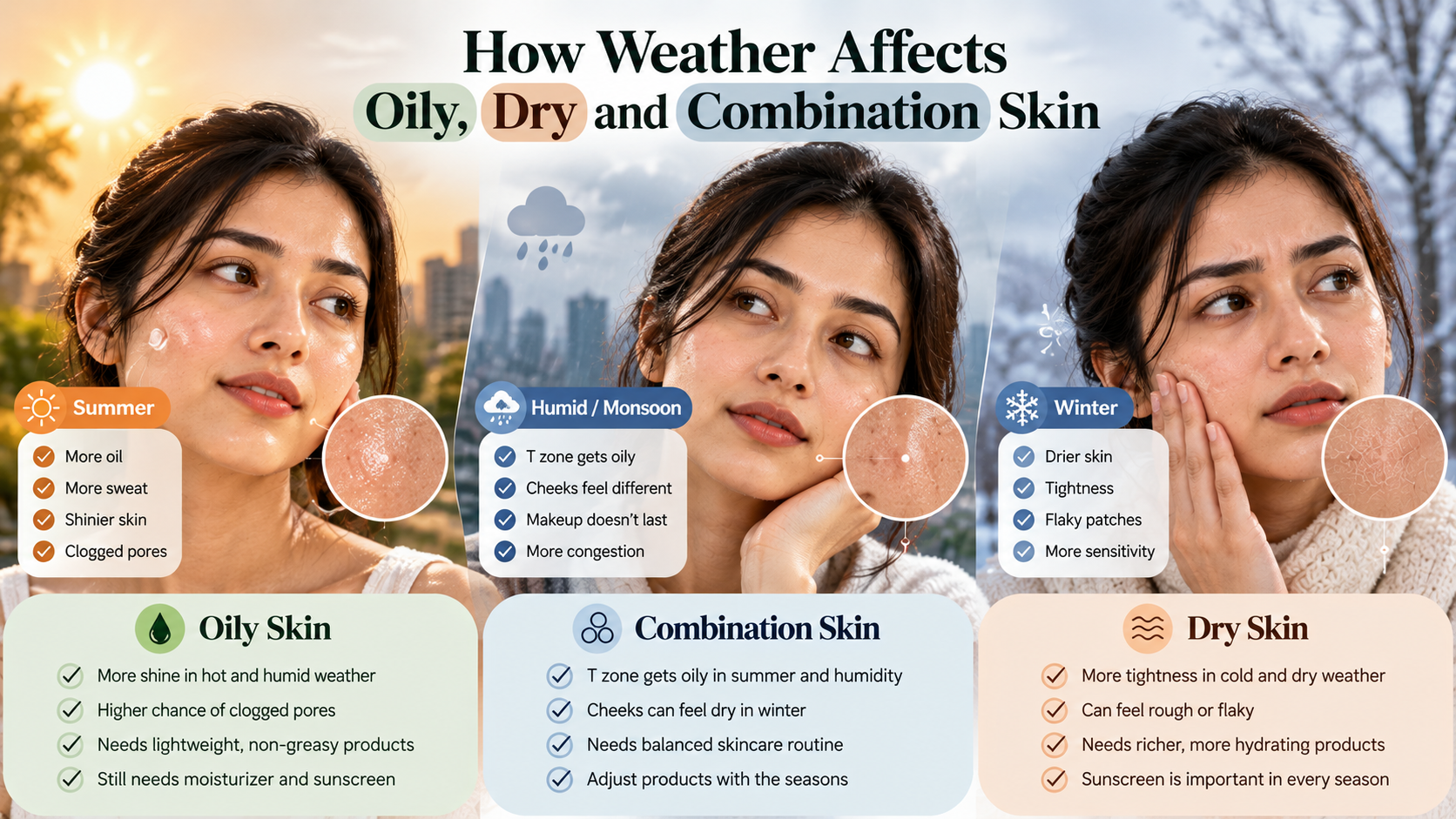
Someone with oily skin may notice increased shine during humid weather, while someone with dry skin may struggle with tightness when temperatures drop.
How Hot Weather Affects Oily Skin
Summer can be particularly challenging for people with oily skin.
Higher temperatures can increase sweating, while heat and humidity may make sebum more noticeable on the skin’s surface.
As a result, your face may look shiny shortly after cleansing.
Common experiences include:
- Increased facial shine
- Makeup becoming greasy
- More noticeable clogged pores
- Sweat accumulating around the forehead and nose
- Discomfort from heavy skincare products
However, having oily skin does not mean your face is dirty or needs aggressive cleansing.
Washing repeatedly with strong products may irritate your skin and leave it feeling stripped.
How to Care for Oily Skin During Summer
Choose a gentle cleanser that removes excess oil without causing tightness.
Lightweight gel moisturizers or lotions may feel more comfortable than rich creams.
For sunscreen, consider a broad spectrum SPF 30 or higher formula with a lightweight finish.
If you experience frequent breakouts, look for products suitable for acne prone skin.
Remember that sweating and oil production are different processes. Your skin may feel greasy because of a combination of sweat, sebum, and skincare products.
Does Oily Skin Become Dry During Winter?
Yes, oily skin can experience dryness or dehydration during colder months.
Even if your skin continues producing sebum, low humidity and indoor heating may increase moisture loss.
You might notice an unusual combination of symptoms.
Your forehead remains shiny, but your cheeks feel tight. Your nose becomes oily, yet certain areas develop rough patches.
This is an important reminder that oiliness and hydration are not the same thing.
Your skin can produce excess oil while still lacking adequate water.
During winter, consider switching to a more moisturizing lotion if your usual lightweight product no longer provides enough comfort.
Avoid assuming that oily skin never needs additional moisture.
How Cold Weather Affects Dry Skin
Winter can be especially uncomfortable for people with naturally dry skin.
Cold outdoor air often contains less moisture, and indoor heating can reduce relative humidity further.
These conditions may increase water loss from the skin, making existing dryness more noticeable.
You may experience:
- Tightness after washing
- Rough or flaky patches
- Increased sensitivity
- Itching
- Dryness around the cheeks and mouth
If your skin barrier is already compromised, these symptoms may become more pronounced.
Winter Skincare Tips for Dry Skin
A gentle cleansing routine is a good starting point.
Avoid washing your face with very hot water, even when the weather is cold.
Choose a moisturizer containing ingredients such as glycerin, ceramides, or petrolatum, depending on your skin’s needs.
Applying moisturizer shortly after cleansing can help retain moisture.
You may also benefit from using a richer cream during winter if your usual lotion no longer feels sufficient.
If indoor air is extremely dry, a properly maintained humidifier may improve environmental comfort.
Can Dry Skin Become Oily During Summer?
People with dry skin sometimes notice more shine during hot weather.
This does not necessarily mean their underlying skin type has changed.
Sweat, sunscreen, humidity, and skincare products can all affect how the face looks and feels.
A dry skin type may still require moisturizing care during summer, although a heavy winter cream might feel uncomfortable.
Instead of abandoning moisturizer completely, consider adjusting the texture.
A lighter lotion may provide sufficient comfort without leaving an excessively greasy finish.
The goal is to maintain hydration while choosing products suitable for warmer conditions.
How Weather Affects Combination Skin
Combination skin can be particularly confusing when the weather changes.
This skin type generally has oilier areas, commonly around the forehead, nose, and chin, alongside cheeks that may be normal or dry.
During summer, the T zone may become noticeably shinier.
During winter, the cheeks may become drier while the forehead and nose continue producing oil.
This creates a challenge because one product may not feel equally comfortable across the entire face.
Summer Skincare for Combination Skin
A gentle cleanser and lightweight moisturizer can provide a useful foundation.
If your cheeks feel dry, you may apply additional moisturizer to those areas without necessarily using the same amount everywhere.
Choose sunscreen that feels comfortable across your face and does not leave your T zone excessively greasy.
Winter Skincare for Combination Skin
During colder months, pay particular attention to areas that become tight or flaky.
You may need a richer moisturizer on the cheeks while continuing to use a lighter texture around the nose and forehead.
Combination skin does not always require separate products for every area. Small adjustments to how you apply your existing products may be enough.
Humidity and Its Effect on Your Skin
Humidity refers to the amount of water vapor present in the air.
High humidity can make the skin feel sticky, especially when combined with sweating and oil production.
This is familiar to many people living in Pakistani cities during humid summer and monsoon conditions.
For oily skin, humid weather may make shine more noticeable.
For combination skin, the T zone may become particularly uncomfortable.
People with dry skin may sometimes experience less tightness in humid conditions, but that does not mean moisturizing is unnecessary.
Low humidity presents a different challenge.
When the surrounding air is dry, water loss from the skin may increase, particularly when the protective barrier is not functioning well.
This is why your skincare needs can change even when your basic skin type remains the same.
How Sun Exposure Affects Different Skin Types
Sun exposure is another important environmental factor.
Ultraviolet radiation can contribute to sunburn, pigmentation changes, premature skin aging, and an increased risk of skin cancer.
These risks apply to oily, dry, and combination skin.
Having oily skin does not provide adequate protection against ultraviolet radiation.
Similarly, people with dry skin should not rely on moisturizer alone for sun protection.
Choosing Sunscreen According to Your Skin Type
For oily skin, lightweight fluids or gel textures may feel more comfortable.
For dry skin, moisturizing sunscreen lotions or creams may be preferable.
For combination skin, a balanced formula that does not excessively dry the cheeks or weigh down the T zone may work well.
Regardless of skin type, choose a broad spectrum sunscreen with SPF 30 or higher.
Apply it generously to exposed skin and reapply approximately every two hours while outdoors, as well as after swimming or heavy sweating.
Shade, protective clothing, and hats also help reduce sun exposure.
How Pollution, Dust and Wind Affect Your Skin
Weather is not the only environmental influence worth considering.
Dust, air pollution, and wind can also affect how comfortable your skin feels.
People who regularly commute through busy roads may notice dirt, sweat, and environmental particles accumulating on their faces.
For oily skin, this can make the surface feel greasy or uncomfortable.
For dry or sensitive skin, exposure to wind and environmental irritants may contribute to discomfort.
However, washing your face aggressively after every outdoor trip is not necessarily helpful.
A gentle evening cleanse is often sufficient to remove accumulated sunscreen, oil, and everyday impurities.
If your skin feels irritated, focus on maintaining a simple routine rather than adding several strong products.
Should You Change Your Skincare Products Every Season?
Not necessarily.
One of the biggest skincare mistakes is assuming that every seasonal change requires an entirely new routine.
Your cleanser may work comfortably throughout the year.
Your sunscreen may also remain suitable in every season.
The product most likely to need adjustment is often your moisturizer, particularly if your skin becomes significantly drier or oilier.
Pay attention to changes such as:
- Persistent tightness after cleansing
- Excessive shine
- New dry patches
- Increased irritation
- Products feeling unusually heavy
If your skin remains comfortable, there may be no reason to replace products simply because the weather has changed.
A Simple Skincare Routine for Different Weather Conditions
You do not need a complicated routine to care for your skin throughout the year.
Morning Skincare Routine
- Cleanse gently according to your skin’s needs.
- Apply a suitable moisturizer.
- Finish with broad spectrum sunscreen, SPF 30 or higher.
Evening Skincare Routine
- Remove makeup and sunscreen.
- Cleanse gently.
- Apply moisturizer to support hydration and skin comfort.
During summer, you may prefer lighter formulations.
During winter, richer moisturizing products may be more comfortable.
If you use retinoids, exfoliating acids, or acne treatments, consider how your skin tolerates them when dryness or irritation increases.
Avoid introducing several new products simultaneously, as this makes it harder to identify what is causing a reaction.
Common Seasonal Skincare Mistakes
People often make unnecessary changes to their routines when the weather shifts.
One common mistake is using stronger cleansers during summer simply because the face feels oily.
Another is skipping sunscreen during winter because the weather is cloudy or cool.
Some people stop moisturizing during humid weather, assuming that moisture in the air is enough.
Others continue using harsh exfoliating products despite experiencing winter dryness and irritation.
The better approach is to observe how your skin responds and make adjustments based on actual needs.
When Should You Consult a Dermatologist?
Seasonal changes can cause temporary discomfort, but not every skin problem is related to weather.
Persistent redness, severe dryness, painful breakouts, burning, itching, or unexplained rashes may indicate an underlying skin condition.
Conditions such as eczema, rosacea, and acne can sometimes be aggravated by environmental factors.
If symptoms are persistent, worsening, or significantly uncomfortable, consult a qualified dermatologist rather than repeatedly experimenting with skincare products.
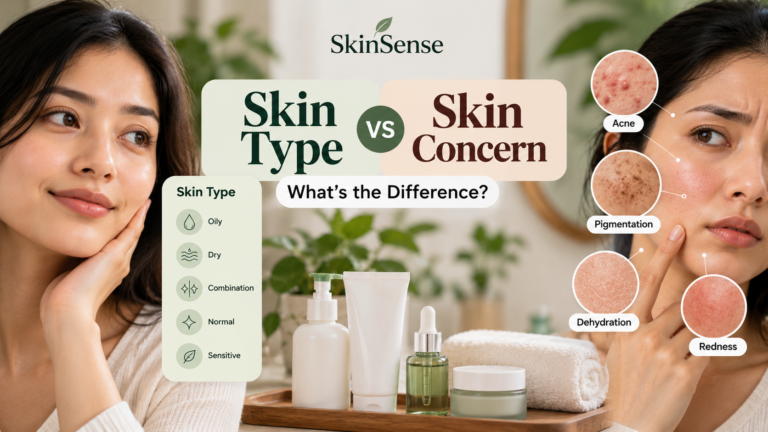
Understand Your Skin Type with SkinSense
Before adjusting your routine for summer, winter, or humid weather, it helps to understand your underlying skin type.
Are you naturally oily, dry, or combination?
Is your skin actually dry, or could dehydration be contributing to the tight feeling?
SkinSense, developed with dermatologist Dr. Usman Lashari, offers a simple skin type assessment based on questions about how your skin looks, feels, and behaves.
The assessment can help you better understand your skin’s characteristics so you can make more informed skincare choices.
Take the SkinSense Skin Assessment: https://skinsense.io
The questionnaire provides educational guidance and is not a medical diagnosis.
Final Thoughts
Weather can influence how your skin behaves, but it does not affect everyone equally.
Oily skin may become shinier during hot, humid conditions. Dry skin may struggle with moisture loss during winter. Combination skin can experience both problems in different areas of the face.
The solution is not to replace your entire skincare routine every season.
Instead, understand your skin type, observe how it responds to environmental changes, and adjust your products when necessary.
A consistent routine built around gentle cleansing, appropriate moisturizing, and daily sun protection can help keep your skin comfortable throughout the year.
Your skin’s needs may change with the weather. Understanding those needs is the first step toward caring for it properly.