Stop Guessing.
Start Knowing
Identify your real skin type and transform your skin.
Get Your InstantSkin Care Routine
Shiny skin is often labelled as oily skin. Tight or flaky skin is usually assumed to be dry. But your skin can be oily and dehydrated at the same time.
This is where skincare can get confusing.
Oily skin and dehydrated skin are not the same thing. One relates mainly to oil production, while the other relates to water levels in the skin. Understanding the difference can help you choose products that better match what your skin actually needs.
What Is Oily Skin?
Oily skin is a skin type. It happens when the sebaceous glands produce more sebum, or natural oil, than your skin needs.
Sebum itself is not bad. It helps protect the skin and supports its natural barrier. The problem is excessive oil production, which can leave your face looking greasy and may contribute to clogged pores.
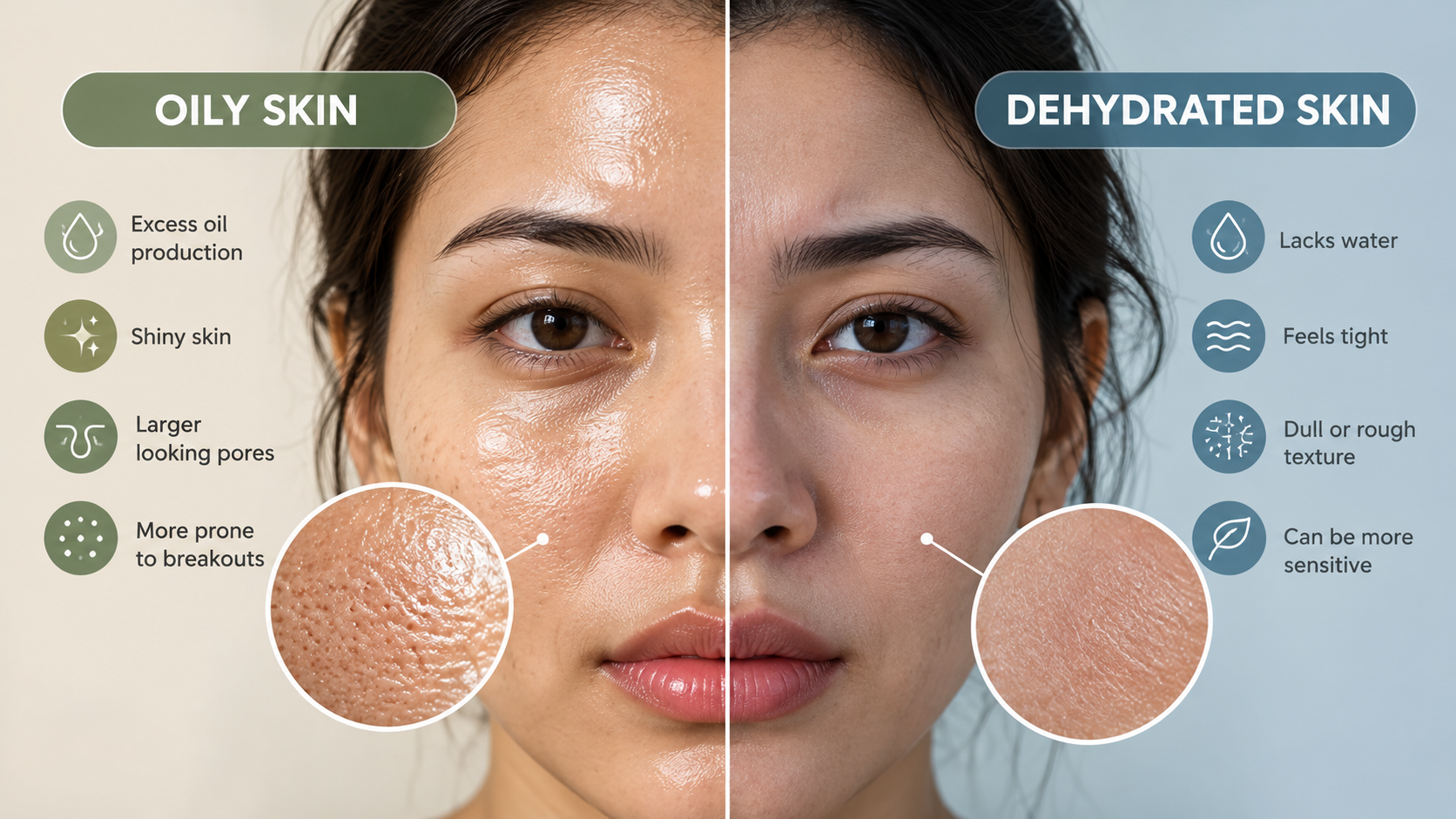
Common signs of oily skin include:
- Noticeable shine across the face
- Oil returning soon after cleansing
- Larger looking pores
- Frequent blackheads or whiteheads
- A tendency toward breakouts
- Makeup becoming shiny or moving during the day
For some people, oiliness is most noticeable around the forehead, nose, and chin. Others experience it across almost the entire face.
What Is Dehydrated Skin?
Dehydrated skin is a temporary skin condition, not a permanent skin type.
It means your skin lacks sufficient water.
This is an important distinction because any skin type can become dehydrated. You can have dry and dehydrated skin, combination and dehydrated skin, or even oily and dehydrated skin.
Signs of dehydration may include:
- Skin feeling tight after cleansing
- Dull or tired looking skin
- Rough texture
- Increased sensitivity
- Fine lines appearing more noticeable
- Flaking in some areas
- Skin that feels uncomfortable despite looking oily
Your skin may even become shiny while still feeling tight underneath. That combination can be particularly confusing.
Oily Skin vs Dehydrated Skin: What’s the Main Difference?
The simplest way to understand the difference is:
Oily skin has excess oil. Dehydrated skin lacks water.
Oil and water play different roles in your skin, so having plenty of one does not mean you have enough of the other.
Someone with naturally oily skin may still experience dehydration due to their skincare routine, environment, or lifestyle.
This is why simply looking at how shiny your face is may not be enough to understand your skin.
Can Oily Skin Be Dehydrated?
Yes. In fact, this is one of the most commonly misunderstood skincare situations.
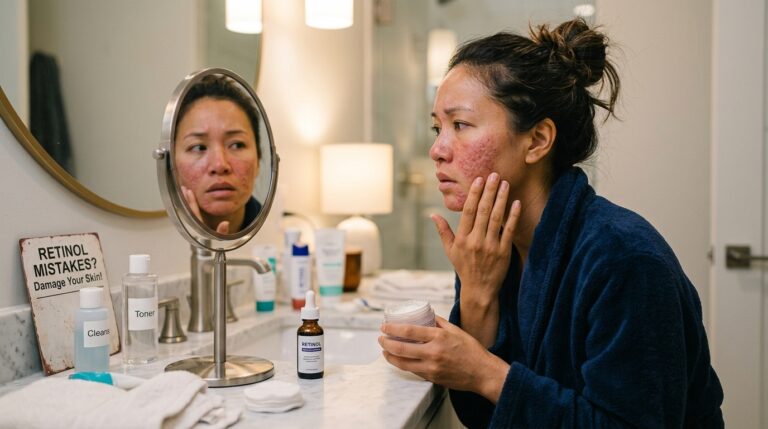
Imagine someone with oily skin who constantly tries to remove every trace of oil. They wash their face several times a day, use a harsh cleanser, skip moisturizer, and regularly use strong exfoliating products.
Their face may still produce plenty of oil, but their skin can begin to feel tight, uncomfortable, or sensitive.
The result is oily skin that is also dehydrated.
Trying to fix this by cleansing even more aggressively may make the skin feel worse rather than better.
What Causes Dehydrated Skin?
There is rarely one single cause.
Your environment and skincare habits can both affect how much water your skin retains.
Possible contributing factors include:
- Harsh or frequent cleansing
- Over exfoliation
- Using unsuitable skincare products
- Not moisturizing appropriately
- Dry weather
- Air conditioning
- Sun exposure
- Changes in your skincare routine
If your skin suddenly starts feeling tight or uncomfortable when it normally does not, think about what has recently changed.
A new cleanser, active ingredient, weather change, or more frequent exfoliation could be contributing.
How Can You Tell Which One You Have?
Pay attention to how your skin behaves throughout the day rather than judging it at one moment.
If your skin regularly becomes shiny across much of your face and has a history of noticeable oil production, you may have oily skin.
If your skin feels tight, dull, rough, or uncomfortable, especially after cleansing, dehydration could be involved.
You should also look at your normal skin behaviour.
Ask yourself:
- Does my skin usually produce a lot of oil?
- Does it feel tight even when it looks shiny?
- Has my skin recently become more sensitive?
- Did these changes start after introducing a new product?
- Am I cleansing or exfoliating more than before?
Looking at several signs together provides more useful information than relying on a single symptom.
Should Oily Skin Still Use Moisturizer?
Yes. Having oily skin does not automatically mean your skin has enough hydration.
The key is choosing a moisturizer that feels appropriate for your skin rather than avoiding moisturizer completely.
People with oily skin often prefer lightweight formulations that do not feel heavy or greasy. Someone experiencing dehydration may need products that help support hydration and the skin barrier.
Your routine does not have to be complicated.
For many people, the foundation is simply:
Cleanser → Moisturizer → Sunscreen
Additional products can then be considered based on individual skin concerns.
Be Careful With Harsh Cleansers
A cleanser should remove dirt, excess oil, sunscreen, and other buildup without leaving your face feeling excessively stripped.
If your skin feels extremely tight immediately after washing, your cleansing routine may deserve another look.
People with oily skin sometimes assume that a cleanser is working only when their face feels completely oil free afterward. That squeaky clean feeling is not necessarily the goal.
A cleanser should clean your skin without making it unnecessarily uncomfortable.
Your Skin Can Change
Another reason oily and dehydrated skin can be difficult to distinguish is that your skin does not always behave the same way.
Weather, age, hormones, skincare products, and environmental conditions can affect how your skin looks and feels.
You might naturally have oily skin but experience more dehydration during certain periods. Someone else may notice their skin becoming oilier during hot, humid weather.
Instead of putting your skin into a permanent box, pay attention to how it behaves over time.
Understand Your Skin Before Choosing Products
Buying products based only on trends can make skincare unnecessarily complicated.
A moisturizer your friend loves might feel too heavy for you. A cleanser marketed for oily skin may feel uncomfortable on your face. A popular active ingredient may not be something your skin currently needs.
Start by understanding your skin type and how your skin behaves.
Once you have that foundation, it becomes easier to make more informed skincare choices.
Not Sure What Your Skin Type Is?
It is easy to confuse oiliness, dryness, sensitivity, and dehydration, especially when several signs appear together.
SkinSense helps you better understand your skin through a quick assessment based on a series of simple questions.
The assessment can give you a useful starting point for understanding your skin type before building your skincare routine.
Take the 1 minute SkinSense Assessment: https://skinsense.io
Final Thoughts
Oily skin and dehydrated skin may look similar, but they describe two different things.
Oily skin is associated with excess sebum production. Dehydrated skin means the skin lacks water.
Most importantly, you do not have to choose between the two. Your skin can be naturally oily while also experiencing dehydration.
Rather than treating every sign of shine with stronger cleansers or skipping moisturizer, look at the complete picture. Understanding what your skin is telling you can help you build a simpler and more suitable skincare routine.