Stop Guessing.
Start Knowing
Identify your real skin type and transform your skin.
Get Your InstantSkin Care Routine
Have you ever noticed that your forehead looks shiny while your cheeks feel completely dry? Or perhaps your nose becomes oily just a few hours after washing, but the rest of your face feels normal.
These mixed signals can make choosing skincare products confusing. A cleanser designed for oily skin might leave your cheeks feeling tight, while a rich moisturizer may make your forehead look greasy.
If this sounds familiar, you might have combination skin.
Combination skin is one of the commonly recognized skin types, yet many people struggle to identify it correctly. The good news is that you don’t necessarily need expensive products or complicated equipment to understand how your skin behaves.
By observing your face and trying a few simple methods at home, you can get a clearer idea of whether you have combination skin.
What Is Combination Skin?
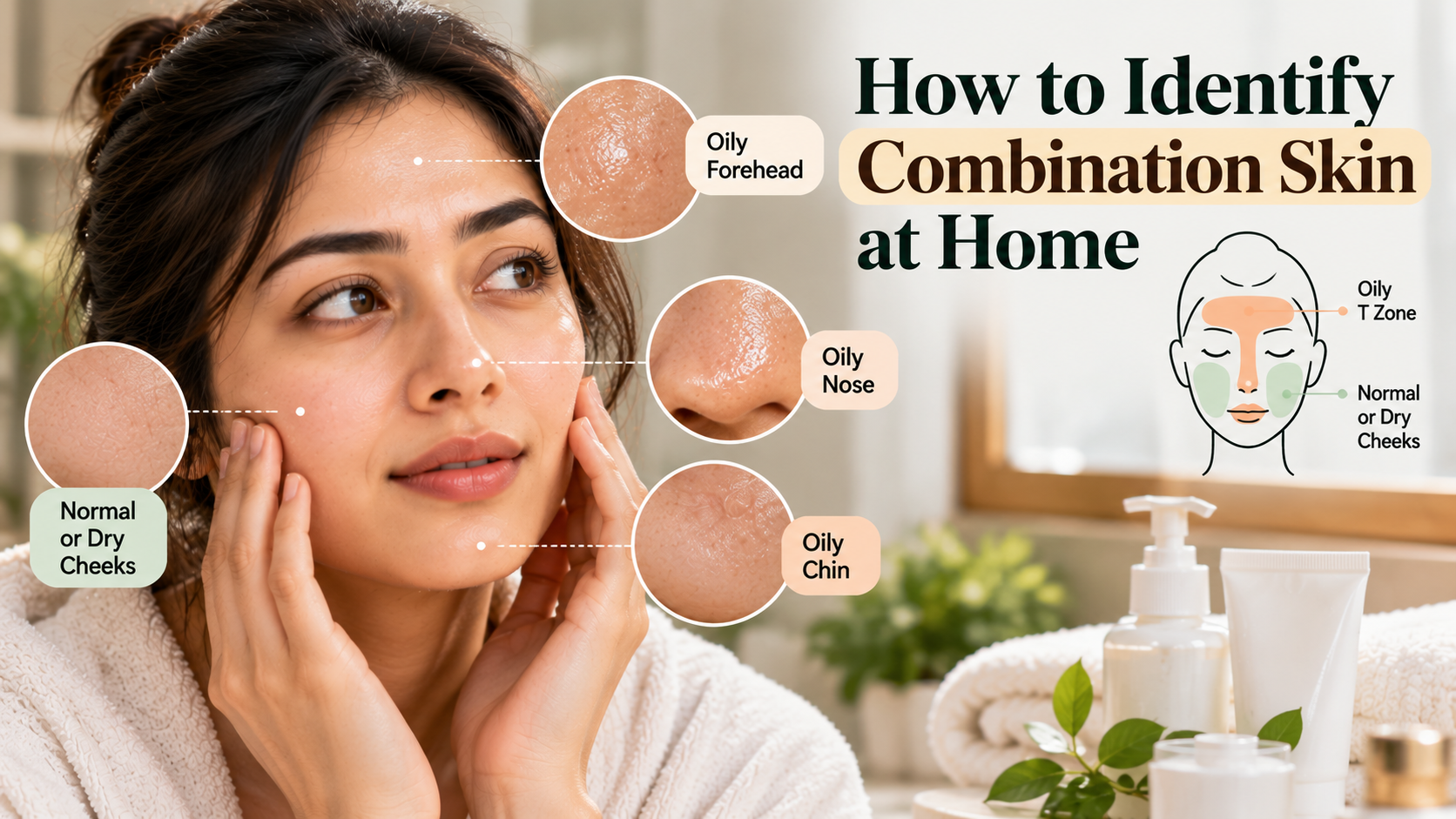
Combination skin means that different areas of your face have different levels of oiliness and dryness.
Typically, the forehead, nose, and chin produce more noticeable oil. These areas are collectively known as the T zone.
Meanwhile, the cheeks may remain normal, feel slightly dry, or develop occasional flaky patches.
For example, someone with combination skin might notice:
- A shiny forehead during the afternoon
- Visible oil around the nose
- Relatively dry cheeks
- Blackheads around the T zone
- Tightness in certain areas after cleansing
However, combination skin doesn’t look exactly the same on everyone.
Some people have a very oily T zone with noticeably dry cheeks. Others experience only mild differences between facial areas.
The key characteristic is uneven oil distribution across the face.
What Causes Combination Skin?
Several factors can influence how oil is distributed across your face.
1. Natural Sebum Production
Your skin contains sebaceous glands that produce sebum, a natural oil that helps lubricate and protect the skin.
These glands are not distributed equally across your face.
The forehead, nose, and chin generally contain more active sebaceous glands than certain other facial areas.
This helps explain why the T zone may become oily while the cheeks remain relatively dry.
2. Genetics
Your natural tendency toward oily or dry skin is partly influenced by genetics.
If combination skin runs in your family, you may notice similar patterns.
3. Weather and Humidity
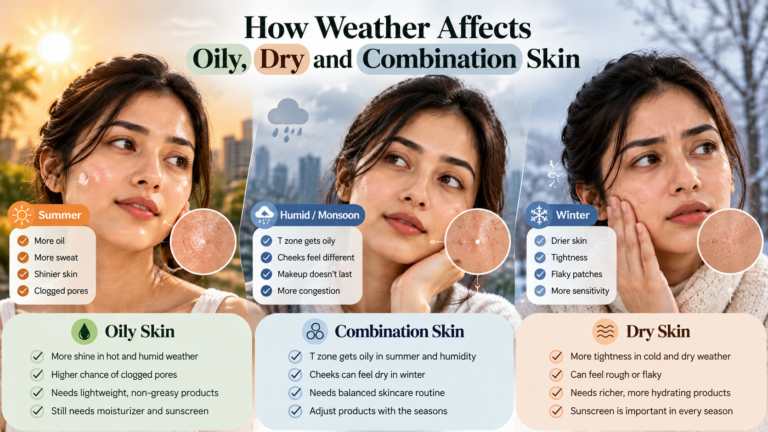
Hot, humid conditions can make facial oiliness more noticeable.
During summer in Pakistan, someone with combination skin may experience a particularly shiny forehead and nose.
During winter, the cheeks may become drier while the T zone continues producing oil.
4. Skincare Products
Using unsuitable products can make differences between facial areas more noticeable.
For example, a strong cleanser may leave your cheeks feeling stripped while your nose becomes shiny again later.
This doesn’t necessarily mean your skin type has changed. Your routine may simply need adjustment.
5 Common Signs You Have Combination Skin
Before trying any home assessment, look for these everyday patterns.
1. Your T Zone Becomes Oily
One of the most recognizable signs is excess shine around the forehead, nose, and chin.
You may notice this a few hours after washing your face.
2. Your Cheeks Feel Normal or Dry
While your T zone becomes oily, your cheeks may feel comfortable, slightly tight, or rough.
This contrast is an important clue.
3. You Experience Blackheads Around Your Nose
The nose often has more noticeable pores and oil production.
People with combination skin may experience blackheads or clogged pores around this area, although blackheads can occur with other skin types too.
4. Makeup Behaves Differently Across Your Face
Your foundation might become shiny around the forehead and nose but appear dry or patchy on your cheeks.
This can happen because different facial areas have different moisture and oil levels.
5. One Moisturizer Doesn’t Feel Equally Comfortable Everywhere
A rich cream might feel excellent on your cheeks but too heavy around your nose.
Similarly, a lightweight gel may feel comfortable on your T zone but insufficient for drier areas.
These patterns can suggest combination skin, especially when they occur consistently.
How to Identify Combination Skin at Home
You can begin with a simple observation method.
This is not a medical diagnostic test, but it can help you understand how your skin behaves without the immediate influence of skincare products.
Step 1: Wash Your Face with a Gentle Cleanser
Start by washing your face using a mild cleanser and lukewarm water.
Avoid scrubbing or using exfoliating products.
Pat your face dry gently with a clean towel.
Step 2: Leave Your Skin Without Products Briefly
For this observation, avoid immediately applying moisturizer, serum, facial oil, or makeup.
Wait approximately 30 to 60 minutes.
Do not intentionally leave your skin uncomfortable for the sake of the test. If it becomes very tight, irritated, or painful, apply moisturizer and stop.
Step 3: Observe Different Areas of Your Face
Look at your forehead, nose, chin, and cheeks separately.
Ask yourself:
- Does my forehead look shiny?
- Is there visible oil around my nose?
- Do my cheeks feel dry or tight?
- Does my chin behave differently from my cheeks?
Step 4: Compare the Results
If your forehead, nose, and chin appear oily while your cheeks remain normal or dry, you may have combination skin.
If your entire face becomes oily, an oily skin type may be more likely.
If most areas feel consistently dry or tight, dry skin may be a better description.
Remember that one observation cannot definitively establish your skin type. Repeat your observations on different days to identify a consistent pattern.
The Blotting Paper Method for Combination Skin
Another simple method involves using facial blotting paper.
Blotting paper absorbs surface oil, making it easier to compare oiliness across different areas.
How to Try It
- Wash your face gently and allow your skin to settle.
- Take separate pieces of blotting paper.
- Press one gently against your forehead.
- Use another piece around your nose.
- Test your chin and cheeks separately.
- Compare how much oil each paper absorbs.
If the papers from your forehead and nose absorb noticeably more oil than those from your cheeks, this may support the possibility of combination skin.
However, blotting paper cannot measure skin hydration or diagnose a skin condition.
Sweat, recent skincare products, weather, and cleansing habits may also influence the results.
Use it as an observation tool rather than a definitive test.
Combination Skin vs Oily Skin: What’s the Difference?
Combination and oily skin can look similar because both may involve visible shine.
The main difference is where the oiliness appears.
Oily skin generally produces noticeable oil across much of the face, including the cheeks.
Combination skin usually has an oilier T zone with cheeks that are comparatively normal or dry.
For example, if your forehead, nose, chin, and cheeks all become shiny throughout the day, oily skin may be more likely.
If only your forehead and nose become noticeably greasy while your cheeks remain comfortable or dry, combination skin may be a better description.
Can Combination Skin Also Be Dehydrated?
Yes.
This is an important distinction because dehydration is often confused with dryness.
Dry skin generally refers to a skin type associated with lower natural oil production.
Dehydrated skin describes a condition in which the skin lacks sufficient water.
Someone with combination skin can experience dehydration, particularly after excessive cleansing, over exfoliation, or using irritating skincare products.
You might notice an oily forehead alongside tightness or discomfort.
If your skin feels unusually tight after washing, don’t automatically assume that you need a stronger cleanser.
Your routine may be affecting your skin’s hydration or protective barrier.
How to Build a Skincare Routine for Combination Skin
Once you recognize the pattern of combination skin, choosing products becomes easier.
You don’t necessarily need a separate skincare routine for every facial area.
Start with the basics.
Choose a Gentle Cleanser
A mild gel cleanser or gentle foaming cleanser may work well for combination skin.
Look for a formula that removes excess oil without leaving your cheeks feeling stripped.
If your skin becomes tight after cleansing, consider whether the product is too harsh.
Use a Lightweight Moisturizer
Combination skin still needs moisturizer.
A lightweight lotion or gel cream may provide a comfortable balance.
If your cheeks require additional moisture, you can apply a richer product to those areas.
There is no requirement to apply exactly the same amount of moisturizer everywhere.
Apply Sunscreen Every Day
Choose a broad spectrum sunscreen with SPF 30 or higher.
Lightweight fluid or lotion textures may feel more comfortable if your T zone becomes oily.
Apply sunscreen generously and evenly to exposed skin. Reapply approximately every two hours while outdoors and after swimming or heavy sweating.
Introduce Active Ingredients Carefully
Ingredients such as salicylic acid or retinoids may be useful for certain skin concerns, but they are not automatically necessary just because you have combination skin.
Avoid introducing multiple strong products simultaneously.
Your skincare routine should address your actual concerns without unnecessarily irritating drier areas.
Common Skincare Mistakes People with Combination Skin Make
One mistake is treating the entire face as oily.
Using aggressive cleansers or drying products everywhere may leave the cheeks uncomfortable.
Another mistake is avoiding moisturizer because the forehead becomes shiny.
Combination skin can still benefit from moisturizing products, especially in areas that feel dry.
People also sometimes change their entire skincare routine whenever the weather changes.
Small adjustments are often enough.
For example, you might prefer a lighter moisturizer during humid summer months and additional moisturizing care during winter.
The goal is balance, not eliminating every trace of oil.
Does Combination Skin Change with Age?
Skin behaviour can change over time.
Hormonal changes, aging, environmental conditions, and skincare habits can influence oil production and moisture levels.
Someone who experienced a very oily T zone during their teenage years may notice less oil production later in life.
Similarly, cheeks that previously felt normal may become drier with age.
This is why it helps to observe your skin periodically rather than assuming that a skin type identified years ago will always behave exactly the same way.
Frequently Asked Questions About Combination Skin
Can combination skin have acne?
Yes. People with combination skin can experience acne, particularly in oilier areas, although breakouts may occur anywhere on the face.
Is combination skin the same as sensitive skin?
No. Combination skin describes differences in oiliness across facial areas, while sensitivity describes a tendency toward irritation or reactions. You can have both.
Should I use two different moisturizers?
Not necessarily. One balanced moisturizer may work well. If certain areas need more moisture, you can adjust the amount or use an additional product where necessary.
Is combination skin permanent?
Not always. Oil production and skin behaviour can change with age, hormones, climate, and other factors.
Can I identify my skin type with an online assessment?
A questionnaire can help you recognize common patterns and understand your skin better, but it cannot diagnose medical skin conditions or replace a dermatologist’s evaluation.
When Should You Consult a Dermatologist?
If your skin experiences persistent redness, burning, severe dryness, painful breakouts, unexplained rashes, or ongoing irritation, consult a qualified dermatologist.
These symptoms may involve more than ordinary differences in oil production.
Identifying your skin type can guide everyday product choices, but it should not replace professional evaluation when a medical concern is present.
Discover Your Skin Type with SkinSense
Still unsure whether your skin is oily, dry, or combination?
SkinSense helps you explore your skin type through a simple questionnaire about how your face looks, feels, and behaves.
Instead of choosing skincare products based only on trends or recommendations from friends, start by understanding your own skin.
Take the SkinSense Skin Assessment: https://skinsense.io
Final Thoughts
Identifying combination skin at home doesn’t have to be complicated.
Pay attention to how different areas of your face behave throughout the day.
If your forehead, nose, and chin regularly become oily while your cheeks remain normal or dry, combination skin may be the best description.
Simple observations and blotting paper can provide useful clues, although neither method offers a definitive diagnosis.
Most importantly, remember that combination skin needs balance rather than aggressive oil removal.
A gentle cleanser, appropriate moisturizer, daily sunscreen, and careful attention to your skin’s changing needs can help you build a routine that feels comfortable across your entire face.